Projective Cards Help & Resources
Projective Cards Instructions
Level 1: Pick a card and share it
Level 2: Share the experience of choosing the card
Level 3: Describe the card in detail
Level 4: Describe the scene using "I"
Level 5: Questions to deepen the projection
Level 6
Level 7: Owning
Level 8
Projective Cards Using the Oaklander Model Course
Learn how to effectively use projective cards in therapy to help clients of all ages enhance their sense of self, experience and express their emotions. This course, led by experts in Gestalt Play Therapy and expressive arts, offers a blend of theory and demonstrations showing how to use projective cards as a powerful media both in-person and online.
This course includes:
- Case study showcasing the impact of projective cards.
- Step-by-step walkthrough for using projective cards in play therapy.
- In-depth exploration of the Oaklander approach and where and how to get or make your own projective cards.
- Practical prompts and examples for therapists working with diverse clients
- Demonstrations on working with adolescents, children, and parents, both online and in-person using projective cards.
This course is ideal for play therapists and educators looking to integrate creative, visual tools into their practice.
Oaklander Model Projective Cards Deck
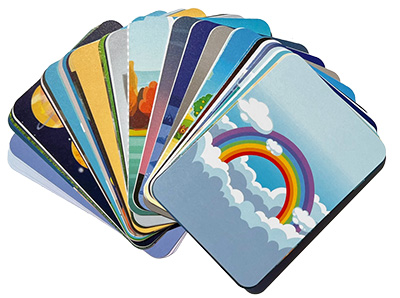
These projective cards have an unlimited number of uses. They are a unique tool that can be used as projections of one’s self. Each deck includes directions with eight different levels of use, 50 full color unique designs, information about the Author Karen Fried, and come in a sturdy plastic box.
Projective cards can be used as a projective activity for children. They are particularly helpful for children who don’t like to draw, or when you are short on time. They can be used in many different ways.
